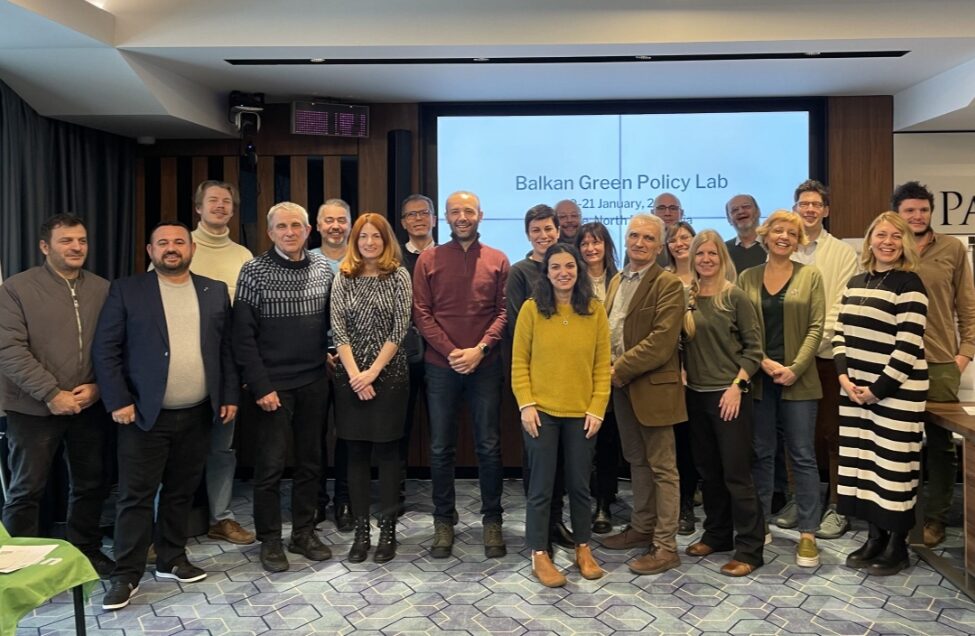
Coming together: the Balkans Green Policy Lab
In Belgrade 2023, representatives from Green parties across the Western Balkans exchanged stories about the challenges they face – from energy policy to the rise of nationalism – and sketched out shared solutions. This gathering was the first step towards what has become the Balkan Green Policy Lab – an initiative aimed at strengthening Green parties’ capacities to address energy challenges.
The Western Balkan’s green transition is hindered by coal dependence, outdated energy systems, and low political ambition. Countries like Serbia and Bosnia and Herzegovina, for example, rely heavily on lignite, one of the most polluting fossil fuels. At the same time, aging infrastructure makes the need to shift to renewables even more urgent, as many power plants are past their lifespan and grids are poorly integrated with EU networks. While governments in the region have made formal commitments to decarbonisation, concrete policy action has been slow.
These are central challenges for Green parties across the region. They are often the ones speaking up against corruption, nationalism, and repression, while promoting a more inclusive and democratic green transition.
Recently, Green movements have begun to break through. Notably, the Serbian Zeleno–levi front (ZLF) has contested in elections and won seats in parliament and gained visibility as a Green political platform, despite only being established in 2023. As noted in the Green European Journal article Born in the Streets: Green Politics in the Western Balkans, a wave of environmental protests across the region is evolving into political action and new political parties. As frustration with mainstream political parties grows and environmental issues become more pressing, Green parties have an opportunity to expand their relevance in the region.
Increasing cooperation and Green policies in the Balkans
The European Green Party’s Balkan Network identified the need for stronger regional policy positions, which led to the launch of the Balkan Green Policy Lab in 2023. The project aims to strengthen cooperation, increase dialogue, and develop Green policies that benefit the entire region. This process also aims to reclaim the narrative on the Green agenda and limit the influence of right-wing and conservative parties.
The political parties involved in the project are Hoćemo (Bosnia and Herzegovina), United Reform Action (URA, Montenegro), Democratic Renewal of Macedonia (DOM), Zeleno–levi front (ZLF, Serbia), and Za-Orah (Green Alternative – Sustainable Development of Croatia).
Together with Green Forum, the involved parties established two main goals:
- Strengthening the Balkan Green Parties’ policy-making capacity, with a focus on energy policy.
- Promoting and improving regional cooperation between Green Parties.
The Policy Lab came out of two workshops in 2023-2024. Participants engaged in discussions to explore potential energy policy initiatives and worked on a regional energy policy roadmap. Moreover, a coordination group was formed to oversee policy development. In 2025, the group decided to dedicate their efforts to developing policy briefs on five topics: nuclear energy, energy efficiency, transition to renewables, CBAM and just transition. Participants also agreed to develop effective communication around their policy proposals.
“This is really the right moment to do something together”
Zinaida Dimitrijević participated in the 2024 Policy Lab with her political party Hoćemo from Bosnia and Herzegovina. The senior energy expert highlighted the importance of the project, especially in the current political environment where the Green movement in the Balkans is growing:
“The Policy Lab is very useful for our region. It gives us a chance to talk about our countries and share our experiences. We discovered that we all face the same problems – and realised that this is really the right moment to act together. As an energy expert, it also gave me a new perspective – to see how energy is viewed by politicians. Exchanging ideas with colleagues from other countries has also been very valuable for me.”
“Regional connectivity can reduce nationalistic tendencies”
Predrag Momčilović also participated in the 2024 Policy Lab. The Belgrade-based researcher and member of the Green-Left Front (ZLF) in Serbia shared the benefits of networking opportunities and discussions. As an academic researcher, he has connected with organisations and researchers:
“I always learn something new. The last event in Sarajevo was really well organised and had a great mix of activism, politics and academia. I work between these layers, trying to translate academic or expert findings into political and everyday life, so I really appreciated that kind of mix at the event.”
He added:
“This kind of regional connectivity can reduce nationalistic tendencies. We decided to work on concrete policy proposals and will start soon. For me, it’s exciting to share this with my party members to increase their knowledge, and also to build my own regional understanding of these topics.”
The next Balkan Policy Lab seminar will take place in early 2026.
Project story by Rebecca Hellgren, Communications Intern, spring 2025.
 Read More