Were We Ever Inside the Amazon? What COP30 Reveals About Climate Politics
A reflection on how financial logics continue to shape climate negotiations – often at the expense of ecological and social perspectives.
Belém, Brasil | 30 November 2025
COP30 has come to an end. Once again, we are told that progress has been made. This time, the summit took place in Belém, at the edge of the Amazon rainforest. Many hoped this would matter – that proximity to one of the world’s most vital ecosystems would influence the tone of negotiations. That it would remind us that climate policy is not only about targets and metrics, but about living systems and the people who depend on them. Yet an important question remains: were we ever truly inside the Amazon?
While the forest was geographically close, it was largely absent from how discussions were structured. As in previous COPs, negotiations unfolded in controlled spaces, shaped by technical and financial language. Ecosystems were described as “carbon stocks” and “services” – as rivers folded into the logic of financial flows. Even here, at the edge of the Amazon, nature was primarily approached through a market lens. Changing the location, it seems, does not change the underlying logic.
The Logic Predates the Crisis
COP30 suggests that the challenge runs deeper than geography – and deeper than the present moment. The overall approach to climate action remains shaped by long-standing economic and political frameworks whose roots stretch back further than climate policy itself. After the Second World War, there was a rare opportunity to build a global trading system that integrated social rights, development, and ecological belonging alongside economic efficiency. That opportunity, embodied in the proposed International Trade Organisation at the 1947 Havana Charter, was lost. What emerged instead was a framework that embedded social and ecological values within market rules, rather than the other way around. Climate governance today is the heir of that choice. The COPs did not create this logic; they inherited it – and cannot think outside it unless that underlying logic is rewritten. This becomes visible in the COP30 Action Agenda, where climate action is framed as something that should “function as an economy in its own right.” Decarbonisation is linked to competitiveness. Ecosystems are treated as investment opportunities. Adaptation is approached through risk management. Oceans and forests are integrated into market-based systems.
These approaches are not neutral. And when they dominate the conversation, they risk not merely crowding out other perspectives, but actively resisting them. At stake is a deeper incompatibility – market frameworks and ecological belonging do not simply need a better balance – they are operating according to fundamentally different logics.
The Voices That Didn’t Shape the Outcome
Some of the most telling moments at COP30 happened outside the formal negotiations. Informal discussions, even among Green actors, repeatedly returned to the same question: how many billions – or trillions – are needed. This reflects how deeply financial thinking has become embedded in climate policy, even among those who have traditionally challenged it. The contradictions surfaced in the formal spaces too. President Lula’s closing speech attempted to reconcile an uncompromising defence of the Amazon with the idea of financing that effort through oil revenues, including from drilling at the mouth of the Amazon River itself. It was a striking illustration of how difficult it has become to argue for the forest without simultaneously framing it as an economic opportunity.
Meanwhile, other voices struggled to gain equivalent influence. Civil society actors, youth representatives, and Indigenous voices consistently called for stronger community ownership, meaningful participation, and alternative ways of understanding climate action. While present, these perspectives were rarely reflected in the final direction of negotiations. This points to a deeper challenge. Climate solutions are not only technical or financial – they are social, cultural, and political. Evidence from both Europe and the Global South shows that transitions are more likely to succeed when they are grounded in local contexts, knowledge, and lived realities, and when those most affected are meaningfully included in decision-making. Research from the ILO, OECD, and EU funded projects consistently shows that climate and industrial transitions succeed when they are anchored in local memory, identity, and knowledge – and fail when they are not.
Rethinking What Counts as a Solution
A key question emerging from COP30 is not only how much we invest in climate action, but how we define what counts as a solution in the first place. Metrics, taxonomies, and risk frameworks play an important role in shaping decisions. But they also shape what becomes visible – and what remains invisible. When ecosystems are treated primarily as assets, this narrows the range of approaches considered viable. Other values – relationships to land, cultural meaning, long-term stewardship – become difficult to integrate into decision-making, not because they are unimportant, but because the dominant frameworks have no obvious place for them.
A forest is not a financial unit. It is a web of relationships – between people, memory, labour, and living systems – that cannot be captured by market abstractions alone. Transitions driven by technical or economic logic alone often struggle to deliver lasting results. More effective approaches tend to engage with these broader dimensions. This is not about rejecting economic tools, but about recognising their limits, and ensuring they do not define the full scope of what climate action can be.
Beyond the Forest at the Door
COP30 did not fall short simply due to a lack of ambition. In many ways, ambition was present. But it also revealed how deeply current approaches remain shaped by existing economic logics and how difficult it is to move beyond them, even when the forest is right outside the door. Addressing the climate crisis therefore requires more than scaling up existing solutions, and more than reforms alone. It requires broadening how we understand the problem itself, and being willing to rewrite the frameworks through which we interpret and govern the living world. This means taking seriously the role of local communities and Indigenous knowledge – not as a footnote to technical solutions – but as a foundation for them. It means acknowledging that climate transitions have social and political dimensions that no financial instrument alone can resolve. And it means creating genuine space in negotiating rooms, in funding decisions, in policy design for perspectives that go beyond market logic.
Forests are not just carbon sinks. They are living systems shaped by relationships between people, ecosystems, and histories. Recognising this does not mean abandoning practical tools or policy instruments. But it does mean grounding them in a broader understanding of what is at stake, and in the realities of the communities who depend on them. Inclusive, participatory processes are not just a matter of fairness – they are a matter of effectiveness. Perhaps the clearest expression of what is at stake came from Djatchy Ka’a, an Indigenous member of the Tupinambá people and founder of Ava Amazônia, whose voice underpins this article:
“COP30 did not fail for lack of ambition, but from an excess – a greedy excess – of a certain kind of ambition. We witnessed the industrialisation of nature behind closed doors. Negotiated climate became the highest expression of the inverted map imposed by our invaders, who built companies so large that one day they decided to call them ‘cities’, causing the extinction of what we know as freelands.”
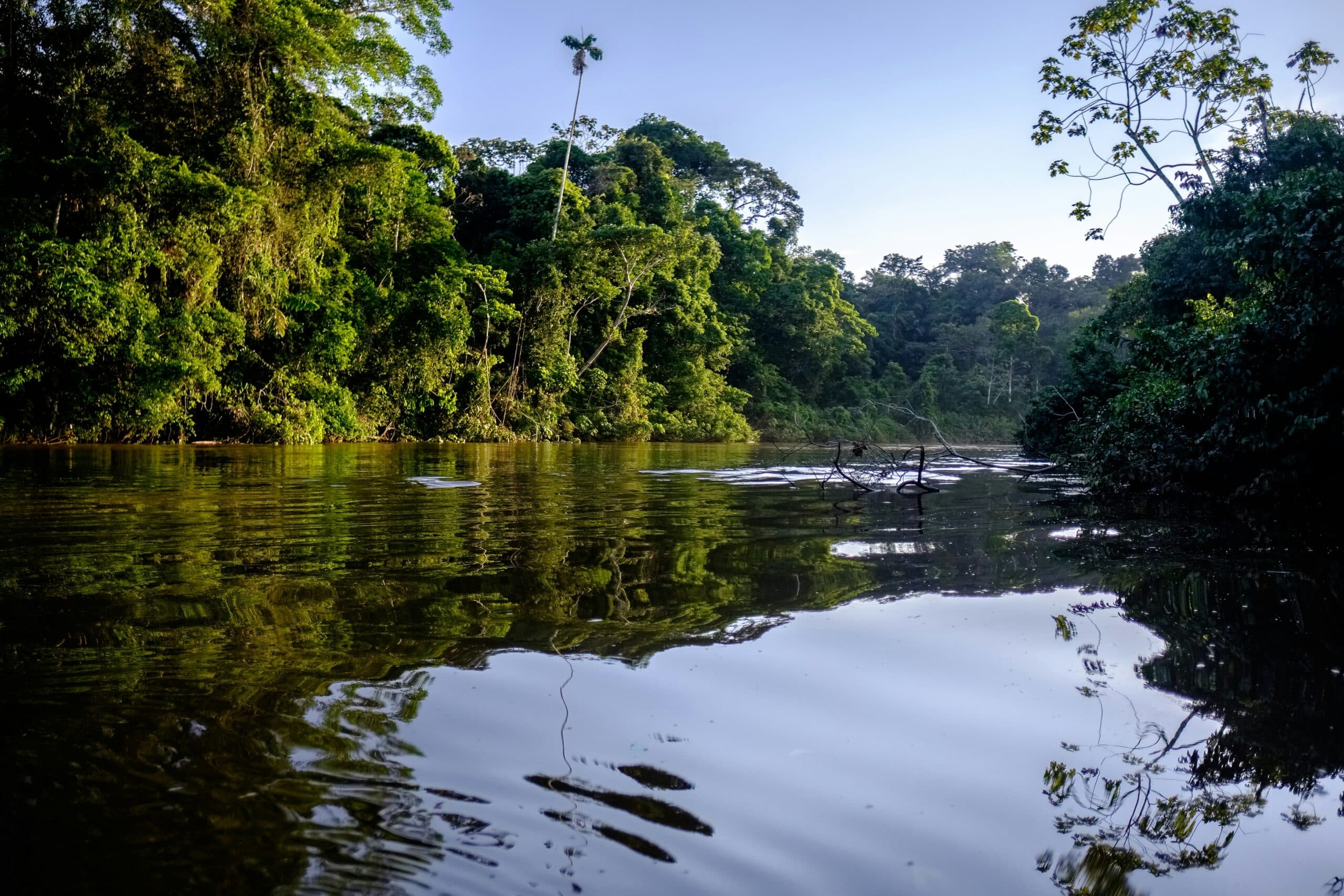
This blog post is based on an article by Ludovic Garattini, PhD, originally published in The Conversation. Translated, shortened, and adapted by Lydia Watchefo and Ansgar Lemke. Image: Forest edge, Amazon region. Photo by Alexander Van Steenberge on Unsplash.
 Read More