Why You Cannot PowerPoint Your Way Out of Patriarchy
What happens when you make inequality something people actually live – not just study? Youth wing members of a Malagasy green party did exactly that in the Gender Reversed Bootcamp, an intense experiment with lasting impact.
A fully immersive experiment
The scenario:
Madagascar, 22nd century. A total civilisational collapse in 2040, caused by climate change and male-led wars, has led to a fundamentally changed society: women now hold power over men in the same way that men hold power over women today.
This is the scenario Dr. Ludovic Garattini, together with experienced trainers, designed for 19 members of the youth wing of a Malagasy Green Party in August 2022.
Crucially, the rules weren’t invented – they were drawn directly from data. Each constraint imposed on male participants corresponded to a documented reality for Malagasy women. The pay gap, the unpaid care work, the economic dependence – each of these was drawn from national statistics, mapping the structural realities of Malagasy women’s lives directly onto the simulation.
In practice, that meant men became:
- Caregivers and reproductive workers
- Subject to dress codes and a curfew
- Ridiculed in job interviews
- Paid three times less than women
And beyond the formal rules, there were subtler humiliations: fined for ‘somatic infractions’ like manspreading, and required to perform emotional labour – smiling, showing gratitude, being pleasant – simply to get paid.
And women became:
- Decision-makers and powerholders
- The “default” gender – for example, the feminine pronoun was used for neutral references in French
- The sole earners and financial controllers
Practical experience instead of theoretical training
The default response from development actors to women’s political exclusion is capacity-building training – equipping women with skills, as if the barrier were individual rather than systemic. This approach falls short, for the same reason that quotas alone fall short: it does not address the underlying dynamics of inequality. Theoretical knowledge is not enough. You cannot “PowerPoint” your way out of patriarchy.
The Gender Reversed Bootcamp addressed both theoretical and practical knowledge: the “Archives of the World Before” provided theoretical grounding, while the structure of camp life made inequality something participants experienced in practice.
What happened
The reactions were immediate and revealing.
At first, the reversal provoked resistance. During a positioning exercise on gender stereotypes, many of the male participants fell back on conservative ideas about their roles – and as the week progressed, tension and frustration surfaced, directed toward the female trainers. But by the end of the week, that same discomfort had taken them somewhere no one had anticipated.
The law the men proposed at the end of the week, which they named L’Androgyne (“the androgyne”), went well beyond quotas or wage reform: a bill to register all persons as non-gendered at birth, leaving gender self-determined until adulthood. Experiencing oppression, it turned out, produces a more radical political imagination than studying it.
A mid-camp field visit brought the simulation into sharp relief. When the group met with a local fishermen’s association, they found themselves watching women who were the demographic majority – and doing most of the work – remain almost entirely silent while the men led. For the male participants, who had spent days experiencing exclusion themselves, it was a jolt of recognition. The women’s silence wasn’t passivity. It was the same structural exclusion they had been living inside the camp.
There was also a moment when the simulation stopped feeling like one. During a session on gender-based violence – framed as studying the ‘Archives of the World Before’ – one female participant realised how deeply she had normalised experiences of abuse in her own life. The moment required intervention from the trainers. And it rippled. The men, watching, understood for the first time that this violence had been happening to people they knew – without them ever noticing.
The women, meanwhile, made full use of their new authority – drafting nearly a hundred laws and regulations, controlling the camp currency, and mimicking the paternalistic behaviours many of them had experienced from male bosses. The women described their feeling as both liberating and weighty.
Perhaps the most striking moment came at the end of the camp, when the women voted unanimously to share power equally with the men – with no external pressure to do so. This wasn’t evidence of innate female benevolence – it reflected how deeply women are socialised toward empathy and care for others.
As Dr. Garattini argues, it is precisely this empathy that makes institutional change possible without annihilation – without the need to completely displace or destroy the opposing side. Power can change hands in two ways: through destruction, or through transformation. It is empathy that makes the latter possible.
Four years later
Four years on, the impact is still alive in small, specific ways. One male participant left the camp with a clear commitment: to drive change in his local political branch. What is striking is that he followed through. He is now not only raising awareness on gender equality in his organisation’s meetings, but has become the driving force behind its gender equality agenda – actively bringing more women into the conversation. Another male participant intervenes when men interrupt women in his association – a small act, but a consistent one. One female participant, now working in diplomacy, draws on narratives developed during the camp to assert authority in high-level international negotiations, rooting her position in a rediscovered Malagasy tradition of female rule and mythical female figures from Malagasy history. In doing so, she is doing something deeply political: using narrative to reframe the discursive contexts through which power is quietly imposed.
Why this matters
The Gender Reversed Bootcamp points toward four practical lessons for those designing and funding gender equality work in political organisations – and what connects them is a single insight: cognitive understanding of inequality isn’t enough. Participants need to feel it in their bodies, their schedules, their wallets. That’s what somatic knowledge means in practice, and it’s what conventional training almost never produces.
- Shift funding from training toward simulation, where results tend to be more durable.
- Target the informal structures that produce inequality, not just the formal ones.
- Embrace productive conflict as a sign of impact rather than failure.
- Root interventions in local contexts and mythologies – not just universal frameworks.
There’s more at stake here. At a moment when empathy is increasingly framed as a weakness in political life, the Gender Reversed Bootcamp points in the opposite direction – suggesting that the capacity to recognise one another as affected beings is not a liability, but the very thing that makes democratic change possible without annihilation.
📖 Curious about bringing a Gender Reversed Bootcamp to your own organisation? The format was developed by Dr. Ludovic Garattini. Get in touch with him through Inkoation to find out more. The material developed for the 2022 bootcamp in Madagascar, including a manual on gender-based violence and gender inequality in the Malagasy context, will soon be available from Green Forum.
📄 The full article, “Somatic Politics: Beyond Capacity Building Traps” by Dr. Ludovic Garattini, is published at ENoP (European Network of Political Foundations). Read it here: Advancing Women’s Political Participation and Empowerment in Africa.
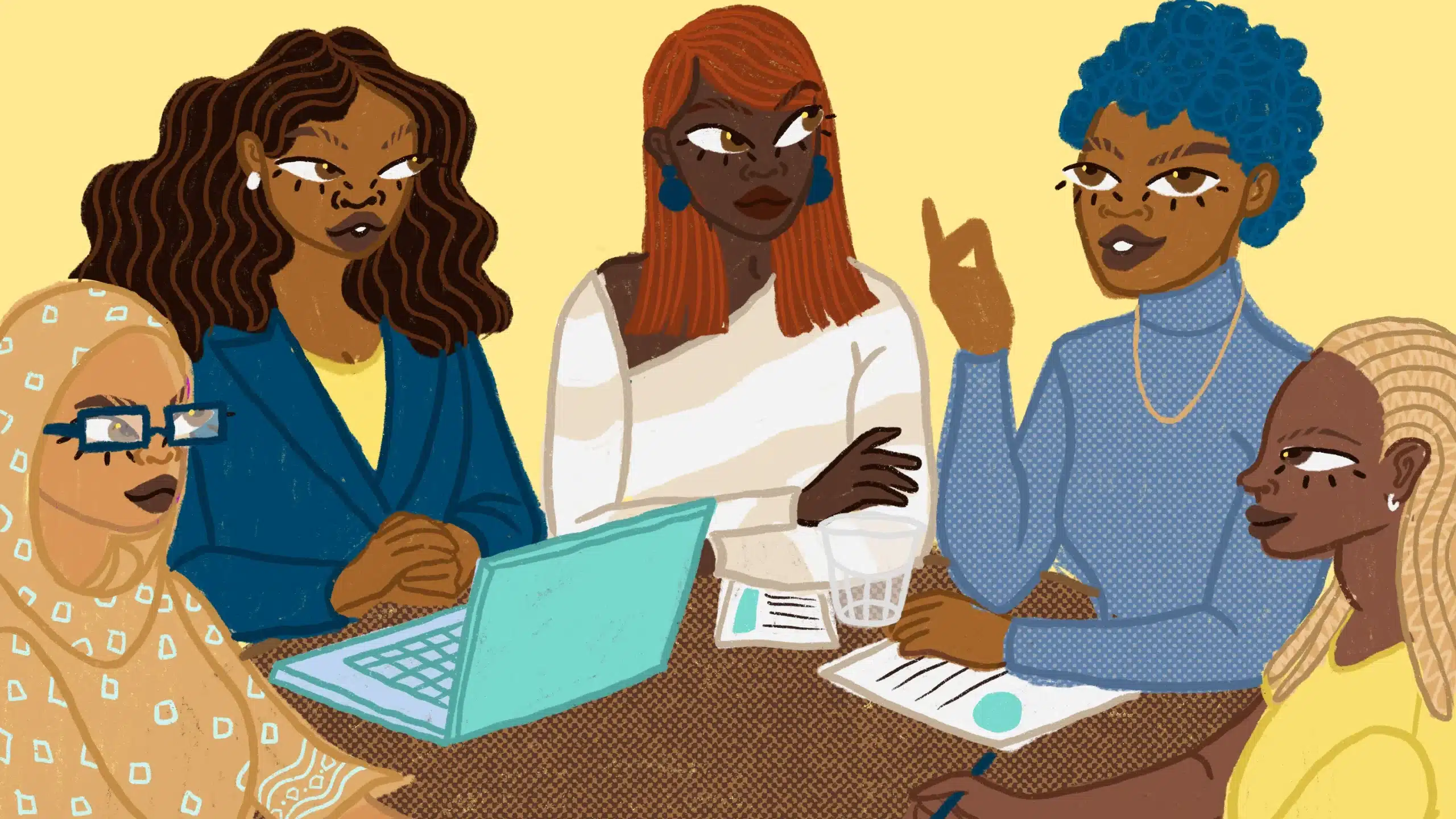
Shortened and adapted for the web by Lydia Watchefo and Ansgar Lemke. Illustration: Precious Narotso, created for the WYDE Political Parties project led by ENoP.
 Read More